

See you on the field: America’s coming decade of sports diplomacy
By Deborah Lehr | As featured in Sports Business Journal
March 31, 2026
More than 2,000 years ago,
the Greek orator Isocrates observed that athletic festivals allowed people to set aside their conflicts, gather together and renew bonds to unite them. The ancient Greeks understood something: Sports have always been a form of diplomacy.
In a world shaped by geopolitical rivalry, economic competition and political polarization, sports remain one of the few truly global languages we share.
Nations compete fiercely on the field, yet still shake hands at the final whistle. It is one of the rare arenas where countries can express national pride without deepening divisions.
Sports have often succeeded where politics struggled. Ping-pong diplomacy helped reopen dialogue between the U.S. and China in the 1970s. Olympic competition provided a rare point of contact between Cold War rivals. Athletes have advanced conversations about opportunity and equality around the world when governments could not.
Yet sports can also reflect and surface geopolitical tensions. Recent U.S.-Canada hockey matchups during the Milan Olympics have carried symbolic weight beyond the rink, reflecting trade tensions between the two countries. And global tournaments increasingly raise questions about how countries such as Iran or Russia will navigate participation amid political strain or even war. Sport both bridges divides and mirrors them.
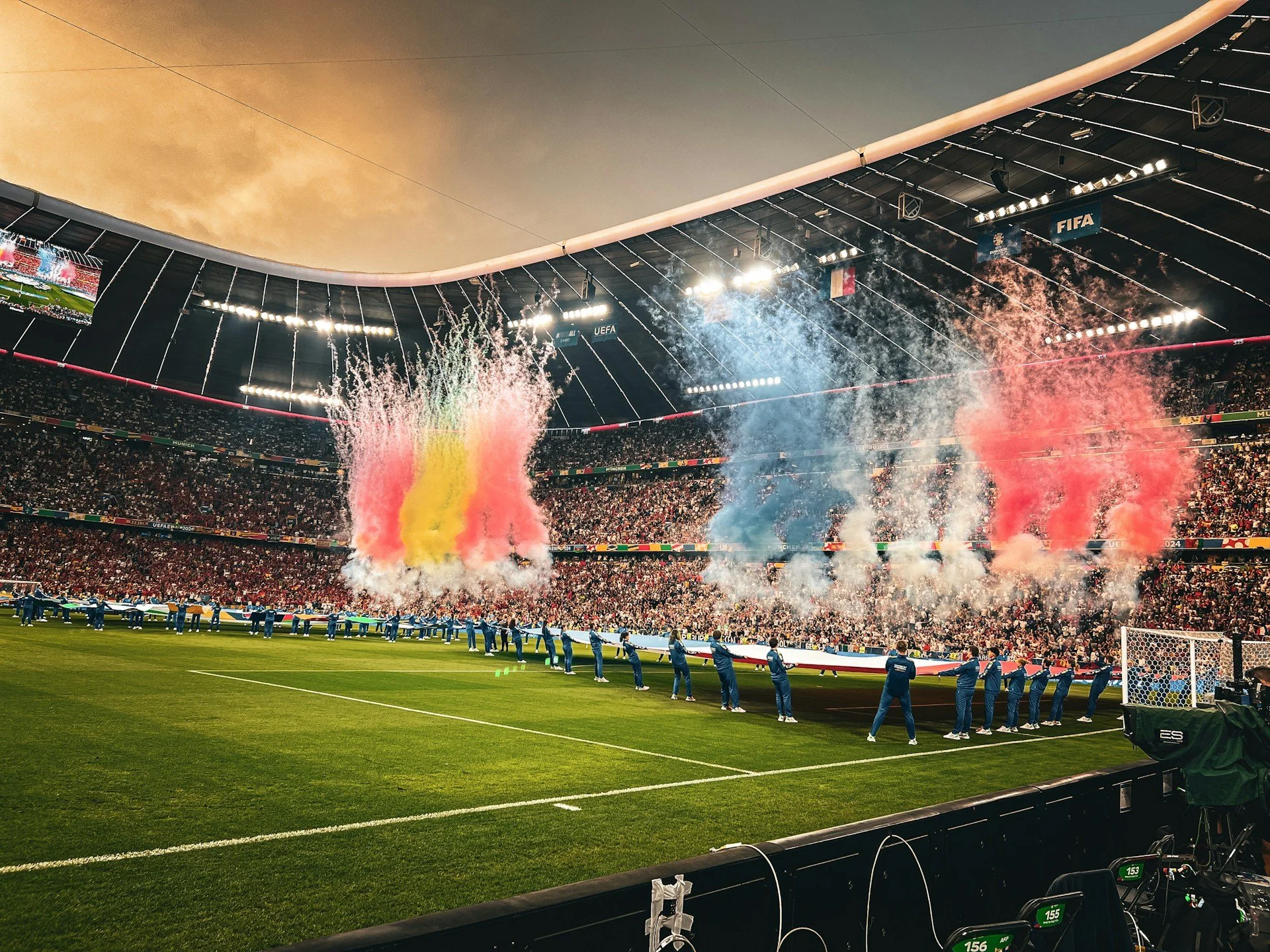
Knockout-Stage European Championship Germany 2024 between Spain and France (Unsplash.com/Johannes Hübner)
What is changing today is not just the diplomatic power of sport, but its scale.
The most influential moments in global sports diplomacy no longer happen only in stadiums. They happen when cities prepare to welcome the world, when investors build leagues that span continents, and when digital platforms connect millions of fans across borders. In many ways, global sport now mirrors the broader international system: Power flows not only through governments, but through cities, capital, technology platforms, and cultural influence.
The coming decade gives the U.S. a rare opportunity to demonstrate leadership across all of these dimensions.
The 2026 FIFA World Cup alone is expected to generate roughly $17 billion in economic activity in the U.S. and create more than 185,000 jobs, while contributing over $40 billion in economic output across North America. Each U.S. host city is projected to see between $160 million and $620 million in additional economic activity, underscoring the scale of the opportunity.
For many visitors, American cities will define their understanding of the U.S. more than Washington ever could. Cities such as L.A., Miami, Dallas, Atlanta, and Kansas City will serve as hosts and ambassadors, welcoming up to 10 million visitors and billions of viewers.
How these cities organize, manage complexity, and extend hospitality will shape global perceptions of the U.S. for years to come.
Sport diplomacy also unfolds at a deeply human level. Millions of fans are expected to travel to North America for the World Cup, creating countless personal encounters that influence how nations see one another. Shared celebrations and friendly rivalries often do more to build understanding than official meetings ever could.
Sport diplomacy also unfolds at a deeply human level. Millions of fans are expected to travel to North America for the World Cup, creating countless personal encounters that influence how nations see one another. Shared celebrations and friendly rivalries often do more to build understanding than official meetings ever could.
At the same time, the globalization of sport is increasingly shaped by investment.
Institutional investors, private equity firms, and sovereign wealth funds are pouring billions of dollars into teams, leagues, and infrastructure. In the U.S. alone, private equity has entered four major leagues — MLB, NBA, NHL, and NFL — with nearly one in five teams now having private equity involvement. With the combined valuation of teams across these leagues approaching $500 billion, sports ownership has evolved into a complex web of global partnerships and shared capital.
Other nations are also recognizing sport as a tool of influence. Saudi Arabia, for example, has invested billions of dollars into global sporting events and leagues as part of its Vision 2030 strategy to diversify its economy and expand its international presence. The kingdom’s sports sector is projected to grow to more than $22 billion by the end of the decade, reflecting how governments increasingly see sports as a platform for both economic development and global engagement.
Technology has expanded the reach of sport even further. Streaming platforms and social media have transformed local competitions into global events. Digital platforms allow fans around the world to follow the same teams and share the same experiences in real time. Algorithms influence which athletes become global figures and which competitions capture worldwide attention. For example, TikTok alone now hosts more than 60 million sports creators, meaning that a single viral moment can now shape global perception as powerfully as a traditional broadcast.
This is diplomacy at scale — often invisible, but immensely effective.
The coming decade places the U.S. in a singular position. As host of the world’s largest sporting events, a leading source of investment capital, and a hub for global technology platforms, the U.S. sits at the intersection of the forces shaping modern sports diplomacy.
The world will be watching not only how American athletes perform, but how American cities organize, how American businesses invest, and how American communities welcome visitors from around the globe.
In that sense, the phrase “see you on the field” takes on a broader meaning. It is no longer only an invitation to compete. It is an invitation to engage.
Published by Basilinna Institute. Featured in Sports Business Journal.