

Trump’s China Visit Signals Emerging Convergence on Iran, But Major Gaps Remain
By the Basilinna Team
May 15, 2026
Your talking points
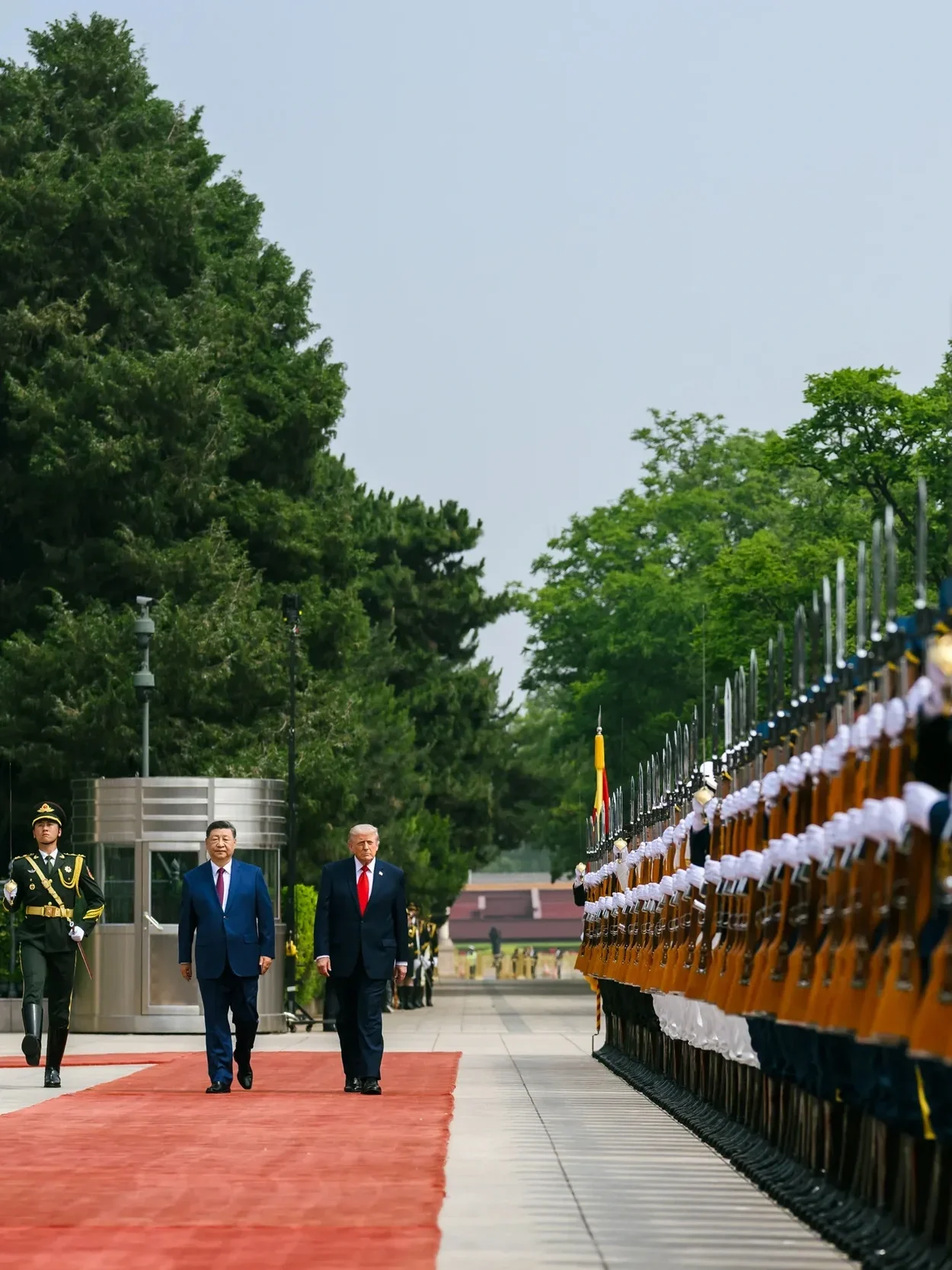
President Trump’s visit to Beijing highlighted the extent to which the Iran conflict has become embedded within the broader U.S.–China relationship, particularly around energy security, global markets, and regional stability.
While no major breakthrough emerged on Iran, both sides’ public statements emphasized two overlapping priorities: preventing Iran from obtaining a nuclear weapon and reopening the Strait of Hormuz.
China appears increasingly concerned about the economic and energy implications of prolonged instability in the Gulf, particularly given its dependence on regional oil and LNG flows.
At the same time, Beijing remains cautious about overtly pressuring Tehran or fully aligning with Washington’s approach, instead continuing to emphasize de-escalation and political settlement.
The visit highlighted that the core obstacle in U.S.–Iran negotiations remain unresolved: the future of Iran’s uranium enrichment program and stockpile.
Markets reacted cautiously. Oil prices rose, Asian equities weakened, and investors appeared unconvinced that the Summit materially reduced geopolitical risk regarding Iran in the near term.
The Summit also reinforced the growing interconnection between Gulf security, U.S.–China competition, energy markets, and global inflation dynamics.
The brief
President Trump and President Xi signaled a mutual interest in stabilizing the U.S.-China relationship through continued high-level engagement, economic ties, and military communication, even as tensions continue over Taiwan, technology, and national security. What is clear Iran is now one of the most consequential issues on the bilateral agenda.
Trump said the U.S. and China were aligned on two core points: Iran must not obtain a nuclear weapon, and the Strait of Hormuz must reopen. He also claimed Xi promised not to send military equipment to Iran, while U.S. officials suggested China opposed Iranian tolls or military control over the Strait.
China’s official readout was more restrained and did not fully echo the White House framing. Beijing emphasized that the war “should never have happened,” called for a ceasefire, and urged a negotiated settlement.
Trump also said he was considering lifting sanctions on Chinese companies buying Iranian oil and will make the decision soon. These were part of a campaign to pressure China into supporting a resolution of the crisis – and China quickly retaliated by threatening action against any U.S. firm that complied with the ban.
China is Iran’s most important oil customer, making their purchases one of Tehran’s key financial lifelines. Any sanctions relief could become part of a broader U.S.–China understanding on Iran, but it could also weaken Washington’s pressure campaign if not tied to China’s support on Iran and Iranian concessions.
The visit also highlighted how the Administration’s Iran calculations are increasingly tied to domestic economic pressures. Rising oil prices, inflation concerns, and market volatility heading into the U.S. midterm election cycle are increasing the urgency around restoring maritime stability and preventing a prolonged energy shock. At the same time, Trump has continued to emphasize that preventing Iran from obtaining a nuclear weapon remains the Administration’s central objective. This may partly explain Washington’s growing openness to interim arrangements — including possible moratoriums or long-term suspension frameworks — rather than insisting exclusively on maximalist outcomes that appear increasingly difficult to achieve in the near term.
Beyond the Points
The significance of the visit lies less in any immediate agreement and more in what it reveals about how China is increasingly becoming a player in global geopolitics with Iran being the immediate issue. And one of the issues to watch is whether the U.S. and China can establish a minimum level of strategic coordination around energy stability. This could impact a resolution with Iran but also China’s relations in the Middle East region. It is interesting that one of the outcomes of the visit is that China will increase its purchases of oil and LNG from the United States.
The summit also reflected China’s steadily expanding role in the MENA region. In recent months, Gulf leaders have intensified engagement with Beijing, including the UAE Crown Prince’s visit to China and Saudi’s Crown Prince Mohammed bin Salman’s recent call with Xi Jinping. Iran’s foreign minister visit China in the weeks before the Trump visit. The Chinese have been in regular contact with Pakistan on Iran issues.
China additionally played an important role in supporting the broader regional de-escalation efforts and diplomatic frameworks that emerged in 2025.
For much of the recent conflict, Beijing largely attempted to avoid becoming deeply involved, balancing its ties with Tehran, Gulf states, and Washington simultaneously while limiting direct security involvement. China’s regional role has nevertheless expanded through energy ties, economic diplomacy, and selective mediation efforts. However, the prolonged disruption surrounding the Strait of Hormuz is increasingly difficult for China to take a back seat.
The market response underscored how central the Strait of Hormuz has become to global energy and pricing dynamics. Brent crude rose above $107 per barrel following the Trump–Xi summit as investors reacted to continued uncertainty surrounding both Iran negotiations and the security of maritime flows through the Strait. Asian equities also weakened following the meetings, while U.S. futures softened amid renewed concerns over inflation, energy disruption, and escalation risk. LNG markets remain particularly exposed given that roughly 20% of global LNG trade normally transits through Hormuz, much of it destined for Asian markets.
Continued disruption is increasing concerns around energy security, shipping insurance costs, inflationary pressure, and broader supply-chain stability across Asia and Europe. Before the war, roughly 20% of global oil and LNG trade passed through the Strait, making Hormuz one of the world’s most strategically significant maritime chokepoints. China remains one of the largest importers of Gulf energy, including Iranian crude, and therefore has a direct economic interest in restoring stable maritime flows and limiting prolonged volatility in regional energy markets.
This creates a degree of strategic overlap between Washington and Beijing, even if their approaches differ significantly. The United States continues to frame the conflict primarily around Iran’s nuclear program and regional military capabilities. China, by contrast, appears more focused on preventing prolonged instability that could disrupt trade, supply chains, and economic growth.
Importantly, Beijing does not appear eager to abandon Iran altogether. Iran continues to hold strategic value for China as part of its broader regional balancing strategy and as an important energy supplier operating outside Western sanctions frameworks. China’s threats to retaliate against U.S. firms complying with sanctions tied to Chinese purchases of Iranian oil further underscored the limits of any emerging convergence. However, the longer the crisis continues, the harder it becomes for Beijing to simultaneously preserve its strategic partnership with Tehran and its economic interest in regional stability. Analysts also remain skeptical that China would exert significant coercive pressure on Tehran beyond encouraging negotiations and opposing escalation. The Summit therefore reflected limited convergence rather than full coordination.
The future of Iran’s enriched uranium stockpile remains the central unresolved issue. Washington continues to seek strict limitations or suspension of enrichment activity, while Tehran insists that enrichment rights and strategic deterrence remain non-negotiable.
Neither the U.S. or Iran currently appear politically capable of accepting the other’s preferred end state: Washington continues to seek an effectively irreversible rollback of Iran’s nuclear capabilities, while Tehran views the preservation of enrichment capacity and strategic deterrence as central to regime survival and sovereignty. Discussions surrounding possible moratoriums, monitored suspension periods, or external custodianship of uranium stockpiles therefore remain politically sensitive for all sides.
The Strait of Hormuz also remains a major pressure point. While some shipping activity has resumed under limited conditions, broader commercial traffic remains significantly disrupted due to security concerns, insurance costs, and uncertainty surrounding future escalation. Gulf states are accelerating efforts to diversify export routes where possible, including additional pipeline infrastructure bypassing the Strait.
If disruption persists, the consequences are likely to extend well beyond the immediate conflict itself. Gulf producers are accelerating investments in bypass infrastructure and export diversification, while major Asian importers are increasing strategic reserves and seek greater supply diversification. Shipping and insurance costs could remain structurally elevated even after active hostilities subside, embedding a longer-term geopolitical risk premium into global energy markets. The crisis may also push Washington and Beijing toward more regularized forms of coordination around energy security, even as broader strategic competition between the two powers continues to intensify elsewhere.
Published by Basilinna Institute. All rights reserved.
