Trump-Xi Summit: What Was Agreed and What Comes Next
By the Basilinna Team
September 29, 2026
Key Takeaways
More Than “Diplotainment”
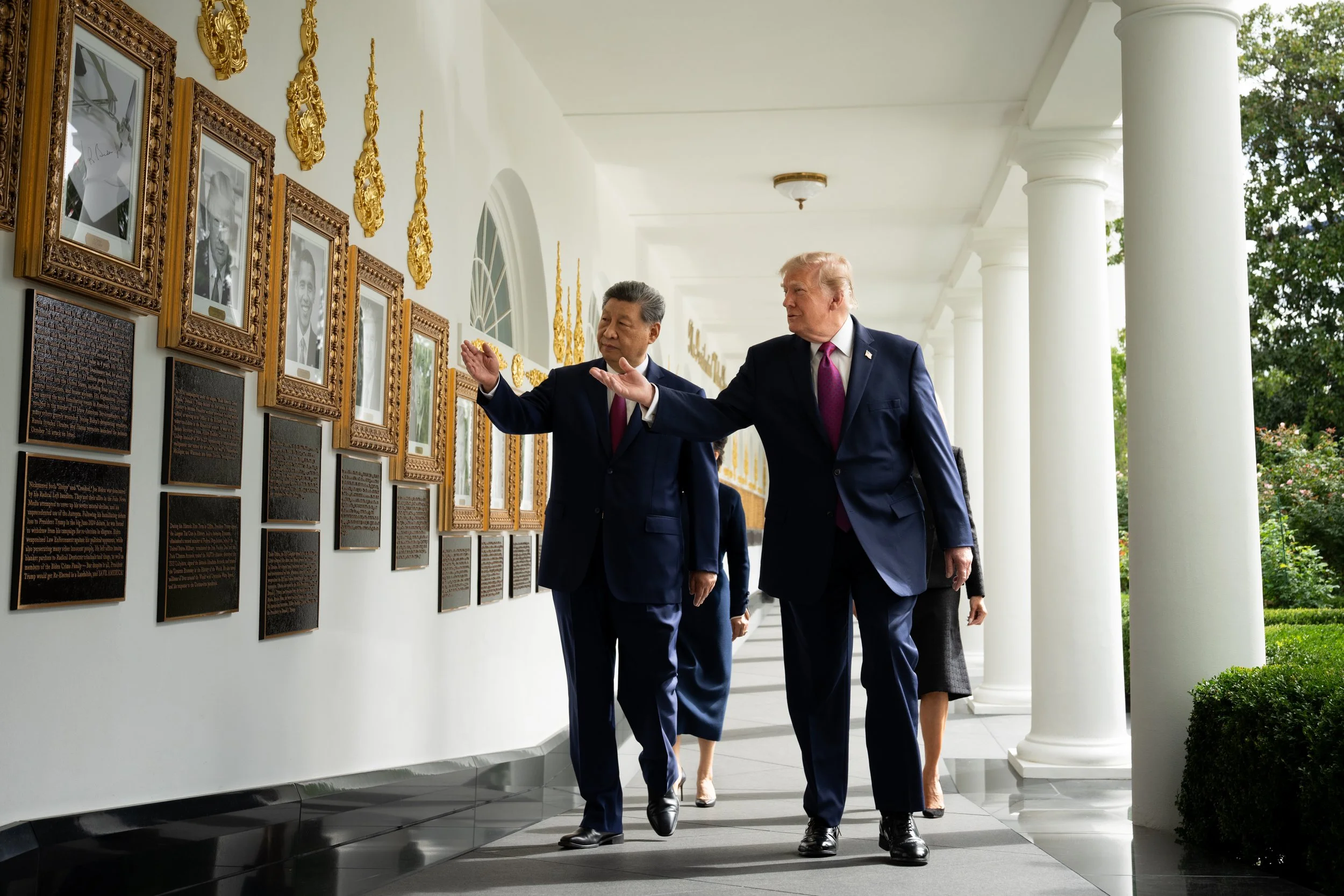
The Trump-Xi summit was certainly an exercise in “diplotainment”—but it was more than that. President Trump rolled out an extraordinary red carpet for Xi, from personally greeting him on the tarmac to the full pageantry of a state visit. The warmth itself was a signal: both leaders remain invested in putting a floor under the relationship, creating greater stability and predictability, and avoiding mutually assured economic disruption—at least through the U.S. midterms.
Modest Progress, Enduring Competition
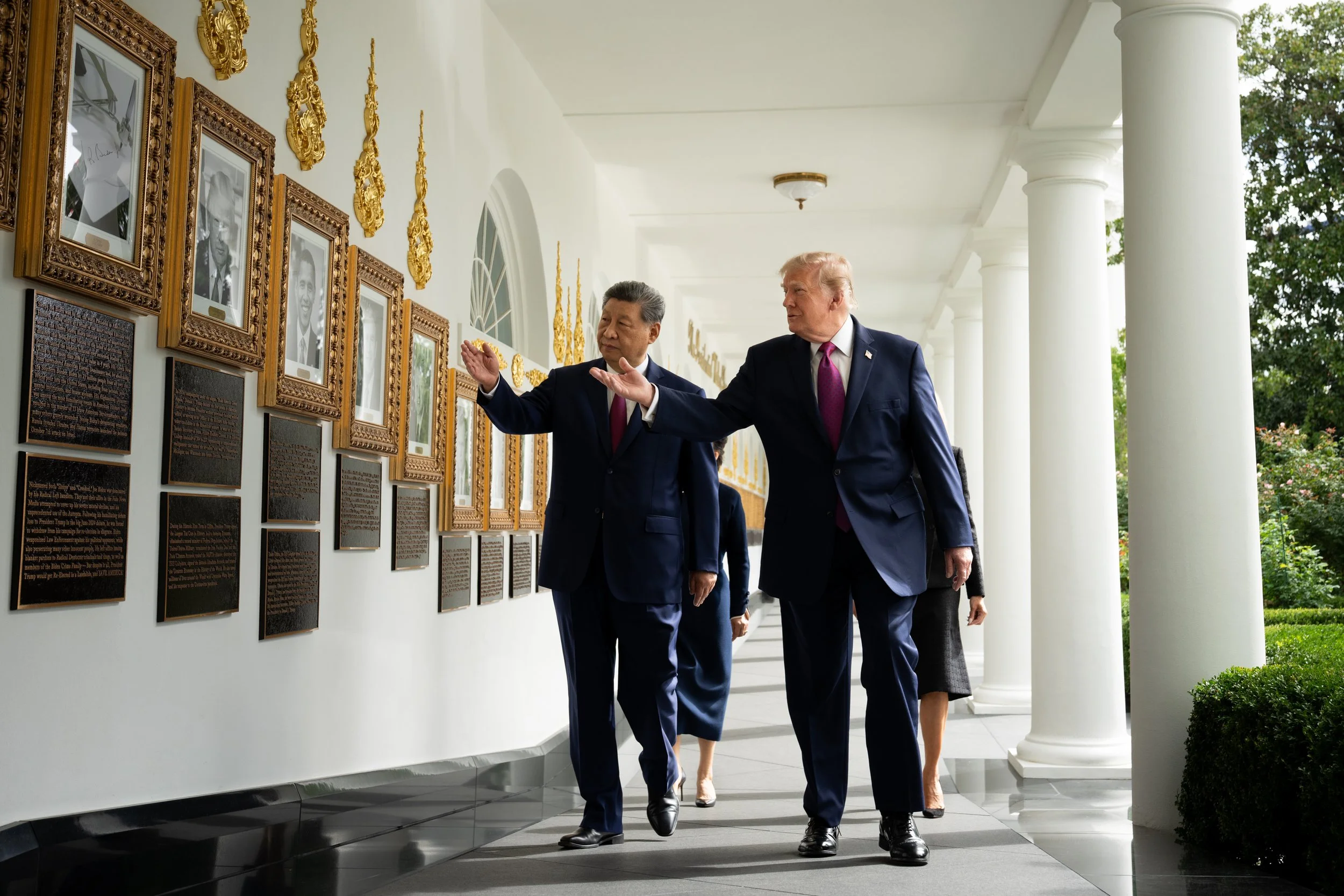
A military review and a performance by the Army Fife and Drum Corps take place in the White House Rose Garden during a State Arrival ceremony for CCP General Secretary Xi Jinping and First Lady Peng Liyuan, Thursday, September 24, 2026. (The White House)
The formal deliverables were relatively modest. The two sides made progress on the Board of Trade, moved toward reciprocal tariff reductions, announced new Chinese purchases of U.S. agricultural and energy products, and extended the trade truce—but for only two months, prompting some surprise in Chinese commentary over the limited extension. One notable area to watch is AI: the new bilateral dialogue and incident channel represent a rare attempt at cooperation on an emerging global-governance issue, even as neither government is interested in slowing AI development, which remains at the core of the competition between the two countries.
The broader relationship remains deeply competitive. And Washington’s unusually warm embrace of Beijing—particularly the references to the United States and China as World War II allies—may leave Japan questioning where it fits, underscored by Prime Minister Takaichi’s immediate follow-up with Trump after the summit.
What Comes Next
But this summit was not a feature film. It is better understood as the latest installment in a miniseries of leader-to-leader engagements. And as with any miniseries, events unfold in each episode, often with a big announcement at the end. Trump and Xi are expected to meet again at APEC in Shenzhen in November and the G20 in Miami in December. Working-level discussions continue, more details are likely to trickle out, and those next two meetings provide opportunities for further progress. There is more to come. And two little ambassadors are already on the job: the pandas have landed in Atlanta and are assuming their own role in the relationship.
Appendix
Key Outcomes from the Trump-Xi Summit
As of September 29, 2026| Discussion Item | Chinese Account | U.S. Account |
|---|---|---|
| Strategic | ||
| U.S.–China Relationship | Agreed to build a “constructive and strategically stable U.S.–China relationship based on respect, fairness, and reciprocity.” | |
| Follow-up Visits / Summits | Mutual support for hosting APEC/G20; both leaders intend to attend the other’s summit. | |
| Trade | ||
| Board of Trade |
Advance Board of Trade; reciprocal tariff cuts on ~$30bn of imports each, with ~90% of covered products reduced to MFN rates. China imports include agriculture, seafood, logs/wood products, coal, cosmetics and medical devices; U.S. imports include home appliances, toys, holiday decorations and child car seats. |
|
| Board of Investment | Agreed to establish Board of Investment for regular dialogue on investment opportunities and barriers. | Agreed to establish Board of Investment to discuss opportunities/barriers and provide a structured channel for commercially meaningful issues. |
| Trade Truce Extension | Extend Busan agreement by two months to Jan. 10, 2027, and continue talks, providing time to assess implementation and greater business certainty. | |
| Rare Earths / Export Controls | Not mentioned. |
Continue work on rare-earth/critical-mineral supply shortages and restoring shipments. National-security export controls excluded from negotiations. |
| U.S. Agricultural Market Access |
Established an agricultural working group. Reached positive consensus on certain non-tariff barriers and market-access issues; agreed in principle to include relevant products in the $30bn tariff package. First working-group meeting by end-2026. |
Established an agricultural working group focused on market-access barriers. |
| U.S. Energy Purchases | U.S. coal included in $30bn tariff framework, supporting higher 2027–28 imports. | China to import ≥10mn tons of U.S. coal annually in 2027–28. |
| Agricultural Purchases | Not quantified. | China meeting 25mn-ton soybean requirement; implementation of $17bn other agricultural purchases slower (~$4bn progressing). |
| Boeing Purchases | Not mentioned. |
Of 200 Boeing aircraft announced in May, ~140 progressing well; Documentation underway for another 10. |
| Financial Services | Agreement in principle; China to process foreign financial institutions’ applications and seeks fair treatment for Chinese firms in the U.S. | Bessent said in an interview that further financial-services announcements “may” follow. |
| Risk Management | ||
| AI |
Agreed to establish a U.S.–China AI Dialogue, discuss AI risks and benefits, and create a communication channel for AI incidents. Wang Yi emphasized preventing misuse and malicious use of AI. |
Established a U.S.–China “Superintelligence” (SI) Dialogue on risks and benefits, with the next exchange before Nov. 2026, plus a bilateral SI-incident communication channel. Leaders agreed to use “superintelligence” rather than “artificial intelligence” for the relevant emerging technology. |
| Military Communication | Agreed to make effective use of political and diplomatic channels and maintain regular military-to-military dialogue. |
Militaries will move quickly toward an MOU strengthening crisis communication and prevention and continue cooperation on recovery of missing U.S. service members in China. Trump advocated trilateral U.S.–Russia–China arms-control talks. |
| Fentanyl |
Highlighted joint cases on new psychoactive substances/precursors and dozens of arrests; Deepen law-enforcement cooperation. |
Welcomed scheduling of orphines and controls on two fentanyl precursors; Cited Aug. arrest of 21 Chinese nationals and urged permanent controls/maximum penalties where applicable. |
| Iran |
Iran should remain non-nuclear; No transit fees on international waterways; Xi backed renewed U.S.–Iran talks based on Islamabad MOU. |
Same nuclear/waterway positions; Trump urged Xi to increase refined-product output to stabilize global supply. |
| Russia / North Korea | Not mentioned. | Leaders discussed ongoing concerns involving Russia, North Korea and Iran. |
| Taiwan | Xi reiterated China’s position, urged opposition to “Taiwan independence” and called for cautious handling of Taiwan. |
Trump: “We didn’t talk much about Taiwan.” Rubio: arms sales to Taiwan remain under review. |
| Japan | Citing 80th anniversary of Tokyo Trials, Foreign Minister Wang Yi said both sides share responsibility for preserving postwar order and preventing militarism. | Not mentioned. |
| Other | ||
| Direct Flights | Discussed increasing direct passenger flights; agreed to remain in communication. | Not mentioned. |
| Youth Exchanges | After completing “50,000 in Five Years” early, Xi announced 100,000 U.S. youths over the next five years. | Not mentioned. |
| Panda Diplomacy | U.S. welcomed the arrival of two pandas leased by China to Zoo Atlanta. | |
| WWII Alliance | Recalled the “Flying Tigers” of WWII when China and U.S. fought together as allies. | |
Published by Basilinna Institute. All rights reserved.
Dive deeper
Explore more insights by Basilinna