Between Security & Commerce
How MENA’s Ties with Washington and Beijing Are Reshaping Commercial Opportunity
By the Basilinna Team
August 31, 2026
Your talking points

Cairo Tower in Egypt (pexels.com/Thais Cordeiro)
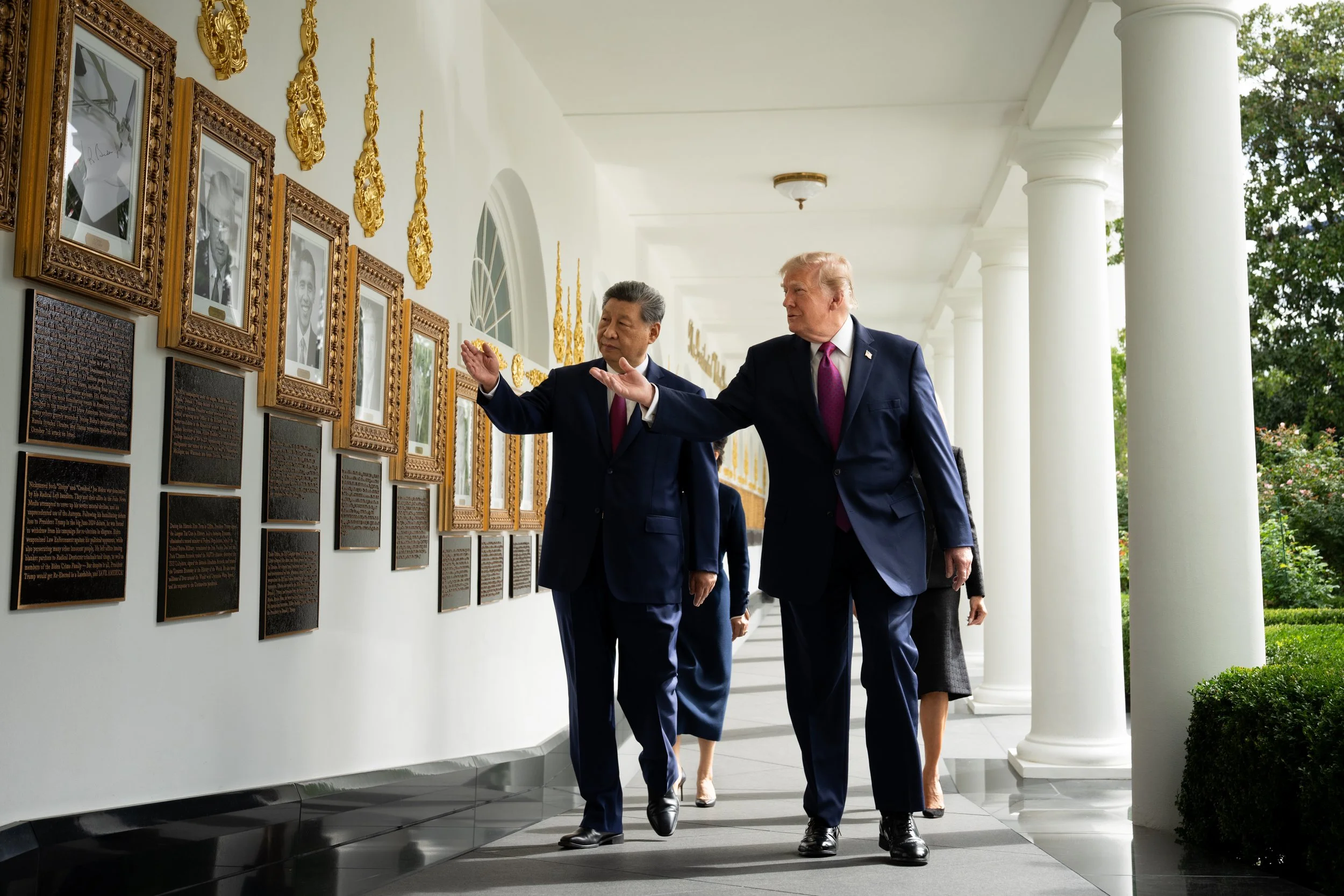
President Xi Jinping’s state visit to Egypt, his first in a decade, highlights China’s deepening economic and political engagement across MENA. But this does not mean the region is shifting from the United States to China. The U.S. remains the region’s primary defense and advanced technology partner, while China is increasingly central to trade, infrastructure, manufacturing and investment.
MENA governments’ ability to deepen economic ties with China while maintaining strong U.S. relationships is creating commercial opportunity, not just geopolitical risk. Governments are working with both powers to diversify their economies, localize industry, attract investment and develop new technologies.
The Gulf is leading this model in MENA. UAE-China non-oil trade reached about $111 billion in 2025, while the UAE committed to a ten-year, $1.4 trillion U.S. investment framework. Saudi Arabia is similarly deepening economic ties with China while expanding investment, technology and defense partnerships with the U.S.
Egypt illustrates the same dynamic. China is Egypt’s largest trading partner, with bilateral trade reaching approximately $20.8 billion in 2025, up from about $17.4 billion in 2024, while the U.S. remains its principal defense partner and Egypt retains Major Non-NATO Ally status. President Xi Jinping’s state visit—the first in a decade and timed to the 70th anniversary of diplomatic relations—underscores the growing political weight behind the commercial relationship.
MENA can maintain relationships with both the United States and China, but American companies cannot—and should not try to—do the same. Their opportunity is to understand the region’s multi-alignment strategy well enough to compete effectively within it. Every company operating in MENA increasingly needs to factor the U.S.-China relationship into its regional strategy.
Beyond The Points
The Middle East is Becoming a Platform Between Systems
President Xi Jinping’s first state visit to Egypt in a decade comes at a moment when China’s economic relationships across the Middle East and North Africa are becoming deeper and more strategic. Yet the significance of that trend is not that the region is shifting from the United States to China. Rather, MENA governments are becoming increasingly adept at building different—and often complementary—relationships with both powers.
The United States continues to provide capabilities that are difficult to substitute: security guarantees, advanced weapons systems, military interoperability, access to the deepest capital markets and—especially in artificial intelligence and semiconductors—frontier technologies subject to U.S. controls. China, meanwhile, is deeply embedded in the region’s commercial economy through trade, energy demand, infrastructure, equipment, manufacturing and increasingly digital and industrial investment. Chinese customs data show that China has remained the Arab League’s largest trading partner for years; in the first seven months of 2025 alone, China-Arab trade reached RMB 1.72 trillion, while Chinese exports of machinery and electrical products to Arab states rose 22 percent.
The central commercial implication is therefore not that businesses must predict whether Washington or Beijing will “win” the region. MENA governments are increasingly managing relationships with both powers, but companies must operate within a more constrained environment. For American companies in particular, the opportunity is not to bridge the two systems, but to understand the region’s multi-alignment strategy well enough to compete effectively within it. The U.S.-China relationship is therefore becoming an increasingly important factor in any company’s MENA strategy.
The Gulf: Turning Multi-Alignment into Commercial Opportunity
Within MENA, the Gulf is furthest along in converting strategic diversification into commercial opportunity. During Abu Dhabi Crown Prince Sheikh Khaled bin Mohamed bin Zayed Al Nahyan’s April 2026 visit to Beijing, the UAE and China highlighted non-oil trade of approximately $111 billion in 2025. The visit produced memoranda covering clean energy, investment, sustainable agriculture, environmental sustainability, health sciences and advanced technology. The breadth matters: the relationship is no longer primarily about hydrocarbons and construction. It is moving into the sectors that Gulf governments themselves have identified as engines of post-oil growth.
At the same time, the UAE has deepened rather than diluted its U.S. economic relationship. The White House announced more than $200 billion in U.S.-UAE commercial deals in May 2025, building on a ten-year UAE commitment to a $1.4 trillion U.S. investment framework spanning AI infrastructure, semiconductors, energy, quantum computing, biotechnology and manufacturing. An accompanying AI agreement tied expanded technology cooperation to protections against diversion of U.S.-origin technology. That is a useful illustration of the emerging model: commercial openness to multiple partners, but with strategic technologies increasingly governed by security conditions.
Saudi Arabia presents a similar picture. China remained the Kingdom’s principal merchandise trading partner in 2025. In the second quarter, China accounted for 14.2 percent of Saudi exports and 27.4 percent of imports; in the fourth quarter it remained the leading partner for both exports and imports. Yet Riyadh also used President Trump’s May 2025 visit to announce a $600 billion U.S. investment commitment, including $80 billion in technology commitments involving companies such as Google, Oracle, Salesforce, AMD and Uber, alongside a U.S. defense sales package valued at nearly $142 billion.
For businesses, the opportunity lies in understanding how to compete within this multi-aligned environment. Gulf states need data centers and power, advanced manufacturing and logistics, clean energy equipment, industrial automation, cybersecurity, life sciences and new supply chains. American and Chinese firms bring different technologies, financing models and market access, while regional governments and sovereign investors maintain relationships with both. For American companies, success will increasingly depend on understanding how these relationships shape procurement, investment and localization decisions, while navigating the security, technology and regulatory constraints that distinguish their position from that of regional actors. This creates opportunities across localization, supplier development, professional services, compliance, market intelligence and investment—not by trying to bridge the U.S. and Chinese systems, but by competing effectively within a region that engages both.
Egypt: Chinese Commercial Depth Inside an American Security Relationship
Egypt demonstrates why the same logic extends beyond the Gulf. China is Egypt’s largest trading partner, and the relationship has continued to deepen. According to Egypt’s State Information Service, bilateral trade reached approximately $20.78 billion in 2025, up from around $17.37 billion in 2024—growth of roughly 19.6 percent. Egyptian exports to China rose to approximately $819 million, while imports approached $19.9 billion, illustrating both the scale of the relationship and the persistent trade imbalance. In August 2026, Egyptian companies also signed 17 export contracts worth approximately $168 million with Chinese buyers across agricultural products, textiles, leather goods and engineering products.
Cairo is explicitly seeking to move the relationship from trade toward production. That effort now has added political momentum. President Xi Jinping is due to make his first state visit to Egypt in ten years as the two countries commemorate 70 years of diplomatic relations, established on May 30, 1956, when Egypt became the first Arab and African country to establish diplomatic relations with the People’s Republic of China. President Xi and President Abdel Fattah El-Sisi are expected to discuss further strengthening the comprehensive strategic partnership, including economic cooperation, while addressing regional and international issues. The anniversary therefore provides more than diplomatic symbolism: it gives both governments a platform to push a relationship already centered on trade and infrastructure further toward investment, industrial localization and technology cooperation.
The commercial logic is compelling. Egypt combines a domestic market of more than 100 million people with the Suez Canal, the Suez Canal Economic Zone, trade access into Africa, the Arab world and Europe, and a government strategy focused on increasing exports and local manufacturing. The TEDA Suez Economic and Trade Cooperation Zone remains a centerpiece of this model, alongside Chinese participation in the New Administrative Capital’s Central Business District and the electric rail system serving 10th of Ramadan City. Chinese investment is also moving further into manufacturing and clean industry, including wind and solar equipment, while major industrial projects continue to be discussed. For Chinese manufacturers facing higher trade barriers or looking to serve African and Middle Eastern markets, Egypt can therefore function not only as a destination market but as a production and distribution base. For Egyptian firms, deeper Chinese investment can bring equipment, industrial know-how, supply-chain integration and potential access to Chinese demand.
None of this has displaced the United States from Egypt’s security architecture. Egypt remains a U.S.-designated Major Non-NATO Ally and its armed forces retain decades of U.S.-supplied equipment, training and interoperability. The relationship has historically been supported by roughly $1.3 billion a year in Foreign Military Financing. Recent proposed sales show its continuing scale: a $4.69 billion program to refurbish 555 M1A1 Abrams tanks, announced in December 2024, and a possible $4.67 billion NASAMS air-defense package approved for notification to Congress in July 2025. The Defense Security Cooperation Agency explicitly framed the latter as supporting the security of a Major Non-NATO Ally.
That combination is commercially significant. Xi’s visit reinforces that Egypt’s relationship with China is becoming more strategic at the same time that its U.S. security relationship remains deeply institutionalized. Egypt can therefore deepen Chinese industrial and infrastructure ties without abandoning the U.S. defense relationship. The resulting opportunity is especially strong in sectors adjacent to—but not necessarily inside—the most sensitive security technologies: industrial parks, logistics, renewable energy, electric mobility, construction materials, consumer manufacturing, agriculture, digital commerce and supply-chain services. Firms able to distinguish politically sensitive sectors from commercially open ones will be better positioned than those treating the entire U.S.-China relationship as a single geopolitical constraint.
Jordan: A Smaller Market with the Same Strategic Logic
King Abdullah II’s August 2026 state visit to China reinforces the point. In Shanghai, the King met executives from Chinese pharmaceutical, food, engineering, agricultural and aviation companies and presented Jordan as a gateway to regional and global markets, emphasizing its business environment and skilled workforce. The visit was deliberately commercial, including engagement around technology and robotics.
Jordan will not match the Gulf in capital or Egypt in market size. Its opportunity is different: human capital, pharmaceuticals, services, logistics, technology and access to neighboring markets. Its growing engagement with China also sits alongside a longstanding U.S. security partnership. That makes Jordan another example of a regional government attempting to add economic relationships without replacing its strategic ones.
Where Businesses Should Look
The practical opportunity created by this environment is larger than the headline value of bilateral trade. Every new cross-border investment produces secondary demand: partner identification, regulatory advice, localization strategies, financing, site selection, government relations, communications, talent, cybersecurity, data governance and supply-chain due diligence. As Chinese companies move from selling into MENA to manufacturing and investing there, these needs become more complex. As American technology companies expand in the Gulf, they face a parallel requirement to understand sovereign investors, national development strategies and local-content expectations.
The most attractive opportunities are likely to cluster around sectors where regional governments are spending heavily and where both Chinese scale and American technology matter: AI infrastructure and data centers; energy and grid infrastructure; advanced and light manufacturing; logistics and ports; electric mobility; renewable energy; biotechnology and health; food security; and digital financial services. The constraint—and therefore another source of advisory demand—is that these sectors do not all operate under the same geopolitical rules. A solar manufacturing project, a cloud platform and an advanced-chip deployment carry very different U.S. security and export-control implications.
This is where the central argument becomes commercially actionable. MENA’s strategic value is increasingly derived from its ability to connect markets rather than belong exclusively to one. Gulf capital can invest in U.S. technology while Gulf companies trade extensively with China. Egypt can host Chinese manufacturing while maintaining an American-centered defense relationship. Jordan can court Chinese investors while remaining a close U.S. security partner. These are not contradictions to be resolved; they are features of the region’s emerging political economy.
For companies and advisers, the winners will be those that can map those distinctions accurately. The opportunity is not to “choose China” or “choose America.” It is to help clients identify where Chinese capital, supply chains and industrial capability can be combined with regional assets and, where relevant, American technology and finance—without crossing the increasingly important boundaries around security, data and strategic technology. As MENA governments become more deliberate in balancing these relationships, that ability to operate between systems is becoming a commercial capability in its own right.
Published by Basilinna Institute. All rights reserved.
Dive deeper
More Insights by Basilinna.